
Artificial Intelligence:
The Tool to Start Thinking Again
One cannot deny that technological development is constantly accelerating and that this, rather than helping us, makes us feel increasingly inadequate, almost ‘overwhelmed’. As strange as it may seem, Artificial Intelligence, rather than contributing to the problem, could be a solution and become the best tool to start thinking again, giving us back our own ‘spaces’.
( by: Antonio Maria Guerra | date: 20/03/2026 )

Why we feel overwhelmed by technology (and how AI can help us).
We live in a paradoxical era: although never before have we had access to so many technological tools, theoretically capable of making many aspects of our daily lives easier, we feel almost ‘crushed’ by them. Well, it’s not our fault — it’s the inevitable symptom of an issue that has already been widely identified and defined as the ‘two-speed crisis’. On one hand, there is technology, whose evolution accelerates continuously and exponentially: new devices and applications, including their updates, multiplying every day. On the other, there is our very human capacity for understanding and adaptation, which remains, by necessity, biologically limited.
Read more
And yet, there is a particular irony in all of this: Artificial Intelligence, which at first glance might seem like yet another Hi-Tech gimmick destined to make things even worse, turns out instead to be the key to solving them. By learning to collaborate with it — rather than passively enduring it — we can in fact ‘empower ourselves’, bridging the gap between the frantic pace of innovation and our human limitations, transforming what seemed like an irreparable fracture into a true synergy.

The 'trap' of continuous overload.
Nowadays, the feeling of always being behind is a very common problem, despite the use of ‘advanced’ technological tools. Emails to read, requests to respond to, meetings to attend, updates to study, and so on. The agenda stops being a simple reminder, becoming, in effect, our master. Time, instead of belonging to us, possesses us.
Read more
This constant pressure generates (at least) three highly undesirable consequences:
- Superficiality: we rush too much to truly delve deeply into anything;
- Reactivity: we respond mechanically to stimuli instead of acting with a clear, reasoned vision;
- Loss of control: we are no longer protagonists of our own lives, but dragged along by events.
When we lack the time to think consciously, we lose the ability to direct our lives.
The false myth of ‘infinite productivity’.
For centuries, the society we live in has pointed us toward a single, viable path: do more, faster, and with ever-greater efficiency. This has given rise to time optimization methods such as the ‘Pomodoro technique’ (*1), as efficient as they are unforgiving. The ‘culture of productivity’ has subtly convinced us that our real value depends on the quantity of things we do.
Such an approach, perhaps flawless from a strictly productive standpoint, has however a strictly biological limitation: we cannot in fact accelerate indefinitely without paying a price. Chronic stress, anxiety, and ‘burnout’ have become a full-blown epidemic because we have persisted in believing that failing to reach our goals, whether self-imposed or imposed by others, was a shortcoming of ours, a kind of ‘sin’, when in reality it was an excess of demands placed on a capacity that is not unlimited.
Notes:
*1: The ‘Pomodoro Technique’ is a time management method that divides work into cycles of 25 minutes of focused concentration followed by 5-minute breaks. Its goal is to improve concentration and better manage mental energy through regular intervals of work and rest.
The mistake we repeat with every new technology.
What is the problem connected to the emergence of a new technology? The answer is simple: almost always we use it to ‘do’ even more than before, rather than ‘lighten’ our daily tasks by optimizing them. The automated management of an email, for example, does not reduce the pressure, but instead creates an irresistible urge to handle even more communications. Even the most sophisticated technological systems, which at least theoretically should give us back time, inevitably end up raising the bar of what we consider ‘normal’.
It’s a spiral: the more productivity tools we acquire, the less free we feel and, in fact, are. Artificial intelligence can, at least potentially, break this vicious cycle, but only on the condition that we use it consciously as a tool to truly help us, thereby regaining control of our time.
Thinking again: a ‘luxury’ within reach, thanks to AI.
The true challenge of an era dominated by Artificial Intelligence is not ‘how to do more and faster’, but, finally, allowing ourselves to slow down, delegating to it all those low cognitive value, often repetitive, activities that weigh us down without giving us anything in return. The ultimate goal should no longer be productivity, but ‘clarity of mind’. Not ‘more tasks completed’, but ‘more accomplished reflections’ that represent real added value. After all, even if we live in a society that wants to convince us otherwise, the quality of our decisions, our relationships and our very life depends on how deeply we are able to think. And to think, we need time: time that we can have back thanks to new technology.

The concept of 'Make Time'
‘Make Time’ refers to the active creation of ‘personal space’: a goal achievable through deliberate choices in the organization of our days and in the selection of tools useful for optimizing them.
In this light, artificial intelligence becomes the ideal tool for focusing on what truly matters, recovering that ‘depth’ which the frenzy of the contemporary world has taken from us.
Let’s look at a couple of concrete examples:
- A professional who uses AI to generate the first draft of a piece of work is finally able to reflect more deeply on its content;
- A student who uses AI to synthesize complex texts frees themselves from the burden of transcription, allowing them to focus on a deeper understanding of the material.
Notes:
*1: The concept of ‘Make Time’ is primarily associated with Jake Knapp and John Zeratsky, who formalized it in their eponymous book published in 2018: ‘Make Time: How to Focus on What Matters Every Day’.

Collaborating with AI: methods and benefits.
Artificial Intelligence is simply perfect at managing repetitive, structured, predictable tasks: precisely those that, with rare exceptions, take up the greater part of our days. Responding to routine emails, processing and organizing documents, transcribing meetings, summarizing reports, filtering information — these are just a few examples of tasks that consume time and energy but require neither creativity nor complex judgment. They keep us busy, no doubt, but without truly ‘making the best use of us’, let alone making us feel ‘fulfilled’.
Delegating this type of chore to AI means freeing up mental and temporal space to dedicate ourselves to what only we can do, namely:
- Think in an original, ‘unpredictable’ way;
- Connect distant ideas;
- Imagine new solutions;
- Grasp nuances;
- Make decisions based on values;
- Build authentic relationships.

Reflection: the ‘ancient’ act we have forgotten.
‘Reflecting’ means analyzing what we are doing, evaluating whether the direction we are following is the right one, and finally understanding the broader meaning of our actions. A fundamental step in re-establishing the connection between ourselves and our time.
In a world that rewards speed, stopping to think is often perceived as a waste of time, when, in fact, it is exactly the opposite: it is genuinely capable of transforming a ‘mechanical’ activity into meaningful action, allowing us to distinguish between being simply ‘busy’ and being truly productive, between doing many things and doing the right ones.
When we actively protect our time in order to dedicate it to reflection, something changes: decisions become strategically sounder, our capacity for understanding expands, and creativity itself benefits. Not because we are more intelligent, but because we are using our brain for what it can do at its best: reason.

The time regained thanks to AI must be defended: every day, without exception.
Freeing up time through AI is only the first step and, paradoxically, the simplest one. The real ‘test’ comes immediately after: such a precious ‘space’ must in fact be actively defended from what constantly threatens it, namely the almost automatic tendency to fill it with new activities. If it is not guarded with determination, the void created by AI will be rapidly colonized by notifications, requests, distractions … and we will find ourselves back to square one.
Read more
Defending the time we have regained therefore means treating it as a non-negotiable resource, which translates into establishing clear spaces in the day, creating boundaries that are difficult to breach, and learning to say no to what does not deserve our deepest attention. Make no mistake, this is not selfishness, but a legitimate and necessary choice, so as to have the opportunity to think, decide and act with clarity and, therefore, with effectiveness.
Conclusion: Artificial Intelligence as a tool for starting to think again.
There is no denying that technology accelerates faster than our capacity to understand and employ it consciously. However, this is not an inescapable fate: it can in fact be faced with the right tools. Artificial Intelligence is without doubt the ideal one, but only if we choose to use it to free up time to dedicate to deep thinking, avoiding intensifying the frenzy any further. Never as in this case does success depend on us, on our genuine willingness to reclaim our time, returning to being masters of our lives rather than servants of an ever-fuller agenda. This is the true promise of new technology: not to make us run even faster, but to give us the time and space to stop and reflect.

Copyright information.
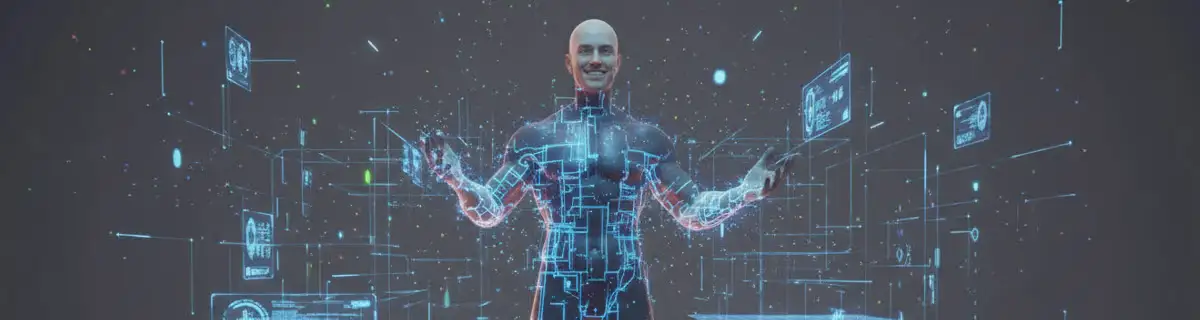
The images on this page were created using generative Artificial Intelligence tools.