

AI Agents:
What They Are and How They Work
There is no doubt that, right now, AI Agents represent the most advanced frontier of artificial intelligence. They are not simple programs that execute predefined instructions, but autonomous systems capable of perceiving their environment and acting without the need for constant supervision. Let’s explore how this new ‘technological wizardry’ works and why it matters so much.
( by: Antonio Maria Guerra | date: 20/03/2026 )

Cosa sono gli agenti IA: definizione e caratteristiche principali.
Imagine an assistant who, once given a task, independently plans the work required, adapting to changes and tackling the challenges that arise along the way. AI Agents are, in essence, software systems that, acting as true ‘virtual assistants’, leverage a range of technologies (including, in more recent implementations, natural language processing and machine learning algorithms) to operate independently toward the achievement of specific goals.
The key characteristics of what is becoming increasingly difficult to categorize as a mere ‘tool’ include:
- Context perception:They gather information from the environment in which they operate;
- Goal orientation:They plan and select the actions needed to pursue the assigned task;
- Memory and contextualization: They use acquired information to guide their own decisions;
- Operational autonomy:They act without continuous supervision, making independent decisions;
- Adaptability: They modify their behavior in response to changing conditions;
These characteristics are grounded in the foundational principles of the agent model introduced by Russell & Norvig in Artificial Intelligence: A Modern Approach (1995) — a work now in its fourth edition and widely regarded as the international academic benchmark for the definition of intelligent agents.
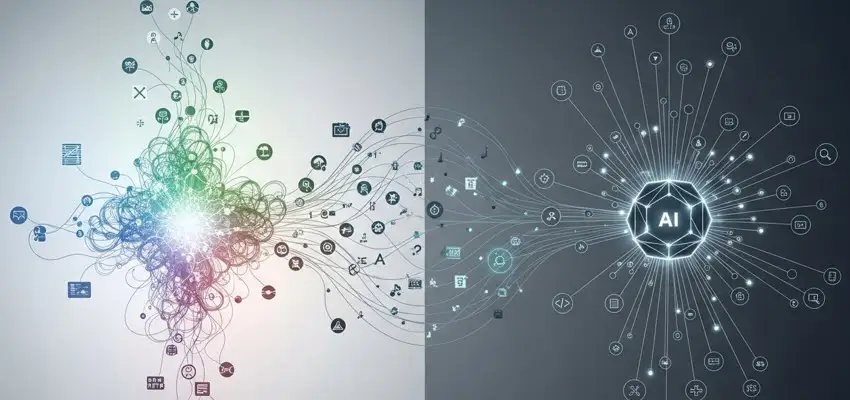
The difference between ‘generative’ AI and ‘agentic’ AI.
Some confusion between ‘generative AI’ and ‘agentic AI’ is almost inevitable, especially for those outside the field, and clarifying how these two technologies differ is essential to understanding their real value and practical utility.
- Generative AI(such as tools like
- Midjourney, Jasper, Copy.ai, SORA, ElevenLabs , etc.) is designed to create content, such as text, images, code, or responses, based on specific prompts;
- Agentic AI, by contrast, is focused on the autonomous execution of structured tasks, which, as such, often involve more than one step. To do this, it is designed to be proactive: once assigned a task, it does not wait for further instructions from the user, but begins working on its own to complete it.
Read more
To put it simply, while generative AI produces an output (the act of creating), agentic AI ‘produces actions’ (the act of doing) aimed at achieving a final result.
Please note: The main LLMs (Large Language Models) available online — such as ChatGPT, Claude, Gemini, etc., offer both ‘generative’ and ‘agentic’ capabilities simultaneously.
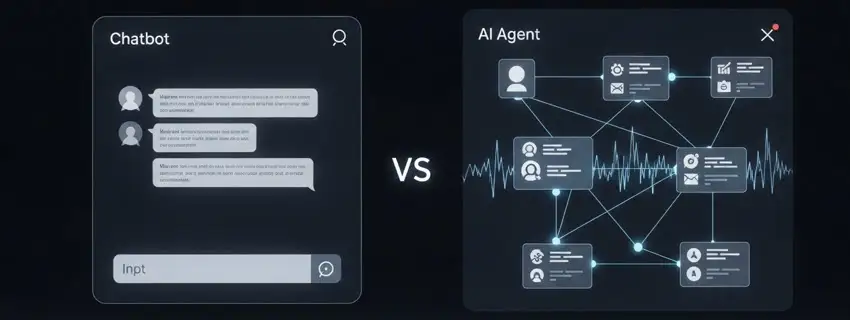
What sets AI Agents apart from ‘ordinary’ chatbots?
Artificial Intelligence technology evolves at such a pace that it is often difficult to follow the various stages of this evolution. AI Agents are a case in point, they can be seen as a natural development of chatbots.
But what exactly has changed? Let’s look at a practical example: when you interact with a chatbot, you typically ask it a question and receive an answer. You ask for advice, you get a suggestion. Nothing more, nothing less. When you think about it, this kind of interaction is fairly limited.
AI Agents go beyond this modus operandi by structuring their responses in a purposeful way. Much like ‘sentient beings’ endowed with their own initiative, when assigned a task they spring into action, autonomously analyzing the situation and devising strategies, while also making use of external tools whenever these can help them accomplish the work.
A classic example, often cited: if an AI agent is asked to organize a trip, it does not simply list the available options, , it does not simply list the available options …
Read more
(as a chatbot would), but instead springs into action, comparing prices across different platforms, checking real-time availability (in real time, of course!), factoring in the user’s past preferences, and even going so far as to complete the booking itself (if permitted to do so).
In short, the fundamental difference between a chatbot and an AI agent lies in the fact that while the former explains how something should be done, the latter actually does it, moving from mere information to real execution.
It is clear that this transformation represents an epoch-making qualitative leap in the — albeit brief — history of Artificial Intelligence, a shift that is redefining the relationship between humans and technology.

How do AI Agents work? The operational cycle.
Let’s explore the complex mechanisms underlying the operation of AI agents. Here we will of course simplify the various steps in order to make them easier to understand for those not ‘in the field’.
Once the input has been received from the user, the following phases begin:

Phase 1: Perception.
The AI agent draws information from a large number of external sources (sensors, databases, the web, data streams, etc.). It is worth noting that this data collection is not random, but tied to the relevance the agent itself assigns to the data based on their actual usefulness in achieving the assigned goal. It therefore ignores everything it deems irrelevant, preserving computational resources for what truly matters.

Phase 2: Reasoning.
Once the data has been gathered, the reasoning phase begins: the AI Agent ‘analyzes the situation’ and develops a course of action. Multiple possible scenarios are examined and the potential consequences of each individual choice are ‘predicted’. Once the numerous variables have been considered, multi-phase strategies are formulated — typically broken down into easily manageable sub-tasks — in order to achieve the goal.

Phase 3: Action.
With a strategy defined, the AI Agent ‘acts’, for instance, by interfacing with external tools, software and platforms to carry out the various planned tasks.

Phase 4: Learning.
By monitoring the results of its own actions, the agent is able to identify what worked and what did not, adjusting its own behavior in anticipation of future tasks. In this way it manages to reduce the likelihood of similar errors, optimizing outcomes. This continuous feedback loop makes the machine, in effect, increasingly efficient and — indeed — ‘intelligent’.

The memory of AI Agents.
One of the most important characteristics underlying the functioning of AI agents is their memory system. Unlike most traditional chatbots which (often due to imposed limitations) forget everything as soon as a session is closed, these ‘virtual assistants’ generally retain a record of the user’s preferences, the operational context and, above all, past interactions. Their ‘memories’ are organized across different time horizons: from short-term memory, which retains information about the current conversation and ensures consistency during complex tasks, to long-term memory, which is responsible for storing knowledge about the user and his habits. It is clear that this latter type of memory is particularly useful in enabling the agent to better understand, and therefore more effectively fulfill, the user,s requests.
The ‘tools’ of AI agents.
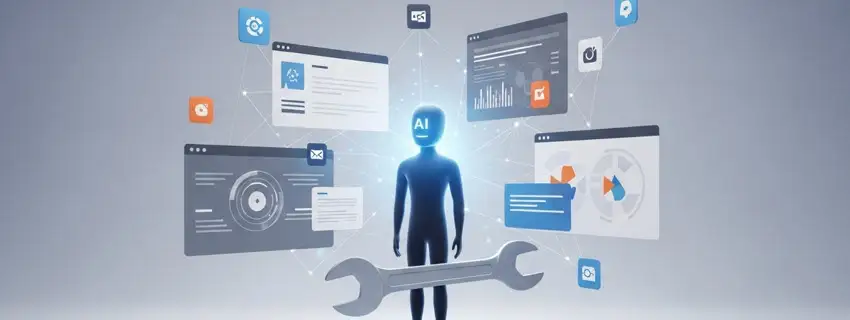
A fundamentally important element in the functioning of AI agents is their ability to interact with external tools: without this capability, their considerable potential would be entirely wasted.
Typically, the ‘tools’ employed range from corporate databases to cloud service APIs, from web browsers to operating systems and so on. This allows them, for instance, to read and write emails, search for information online, manage spreadsheets, generate contextual graphics, execute code and much more.
It is almost needless to point out that the effective management of external resources demands a considerable degree of discernment on the part of the agents, as they must choose — on a case-by-case basis — which tool to use in each specific situation, how to combine them, and how to handle errors or unexpected results.

Collaboration between AI Agents.
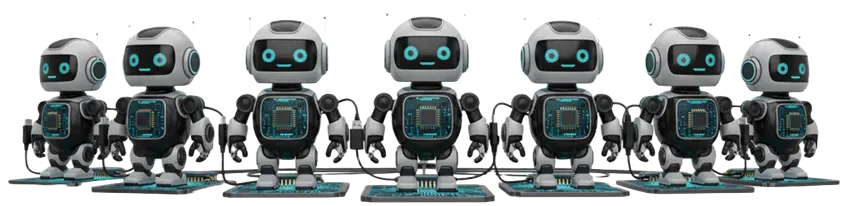
An emerging trend of great interest is that of multi-agent systems, in which several specialized agents collaborate with one another to tackle problems that exceed the capabilities of any single agent. The real challenge lies in optimizing coordination: they must in fact be able to communicate, negotiate and synchronize their activities effectively. It is precisely for this reason that increasingly high-performing protocols and governance mechanisms are currently being studied, with the aim of making cooperation both efficient and, above all, reliable.

The undeniable advantages offered by AI Agents.
The growing adoption of AI agents, not only by individuals, but also by companies, local authorities, and all the way up to national governments, should come as no great surprise, given the undeniable advantages this brings.
Among these, it is worth highlighting the following:
- Operational efficiency: AI agents can easily handle ever-increasing workloads without requiring a proportional increase in staff;
- Decision-making optimization: AI agents excel at identifying details that human operators often overlook, thus enabling more informed decisions to be made;
- Operational continuity: AI agents are tireless workers, capable of operating around the clock without this having any impact whatsoever on their performance;
- Continuous improvement: Every time an AI agent ‘makes a mistake’, it turns the error into an opportunity to acquire new experience — which in turn allows it to continuously improve its performance, especially when faced with critical and/or unforeseen situations;
- Personalization: Every user of an AI agent enjoys a personalized experience, since, for the first time, a tool is capable of understanding the individual preferences of the person using it and adapting to them accordingly.

The challenges of agentic AI.
Despite the great progress made, AI Agents still present significant limitations. The main challenges to be addressed in the coming years relate to:
- Reliability: even minor errors can be critical; multiple verification steps, rollback procedures and constant supervision are essential;
- Computational costs: advanced reasoning cycles demand considerable resources, creating a trade-off between quality and sustainability;
- Context understanding: agents follow instructions literally but struggle with common sense and implicit social norms.

AI Agents in action: concrete examples.
If it is not yet entirely clear just how enormous an impact the use of AI Agents is having across (almost) every sector, the following examples should help give a sense of their actual capabilities:
Financial Sector.
In the financial sector, AI agents are able to monitor global markets around the clock to identify opportunities and risks, executing transactions in milliseconds when necessary. They are therefore capable of making ‘considered’ decisions and acting at a speed unthinkable for any human being, effectively putting traditional professionals out of the game.
Customer Service.
In the field of customer service, AI agents are progressively becoming capable of handling not only routine queries but also highly complex ones. Their responses are moreover often based on the customer’s history, which allows the agent to identify his needs with greater precision.
Information Tecnology.
In the IT field, AI agents are able to detect anomalies in complex infrastructures in real time, diagnosing the issues and attempting to resolve them autonomously. They also have the capacity to manage critical systems with a level of continuity and efficiency superior to that of human operators.
E-Commerce.
An AI agent, in addition to managing orders, processing refunds and monitoring inventory, can also effectively handle numerous aspects of marketing. For instance, it can suggest personalized products to customers — inferred from past purchases — managing to anticipate their needs before they even arise.
How do AI Agents handle uncertainty?
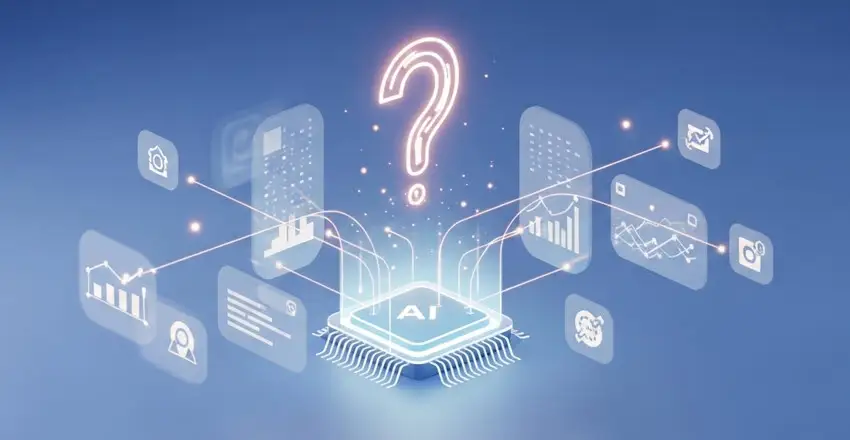
The real world is, as we all know, inherently unpredictable. Incomplete information, random events and ambiguity are the norm. It is therefore legitimate to ask how AI agents can operate effectively even when faced with difficult or unclear situations. The main strategy they adopt is probabilistic reasoning: before acting, they assess the possible consequences of the numerous potential decisions available, optimizing their behavior based on the various possible scenarios. Another crucial approach when doubts arise is the active gathering of information, so as to reduce uncertainty before committing to irreversible actions. AI agents can ask the user clarifying questions, consult additional data sources, or run simulations to test hypotheses.
The risks associated with the use of AI Agents.
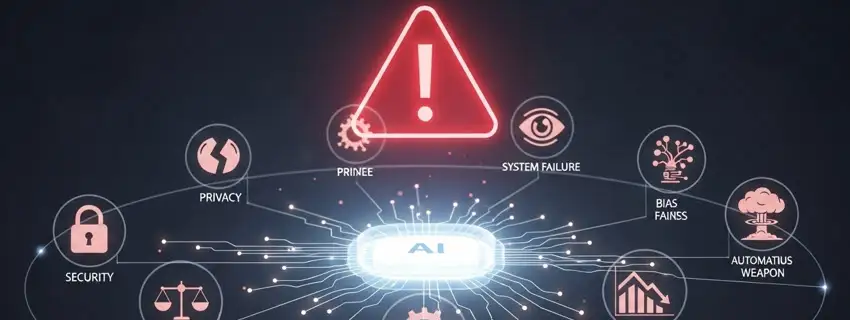
As this article makes clear, AI agents undoubtedly possess remarkable capabilities — but their use also brings with it some fundamental challenges. One of the most significant concerns governance: when an autonomous system makes decisions that generate negative consequences, who is responsible? To this is added the issue of limited transparency, as many agents rely on complex and poorly interpretable models, making it difficult to understand how the machine actually reaches its decisions. Another critical area is undoubtedly data security, given that these systems access large quantities of sensitive information that must be rigorously protected.

AI Agents and the future of work.
AI agents will inevitably have a profound impact on the world of work, offering a form of automation that will enhance the capabilities of professionals such as analysts, doctors and creative workers. New roles dedicated to the management and supervision of these autonomous systems will therefore emerge. There is no point in concealing the fact that more repetitive tasks will be automated, and this will affect employment levels, making staff training and retraining essential. As has happened before with other technological revolutions, people will progressively be employed in activities with greater added value.
AI Agents and AGI.
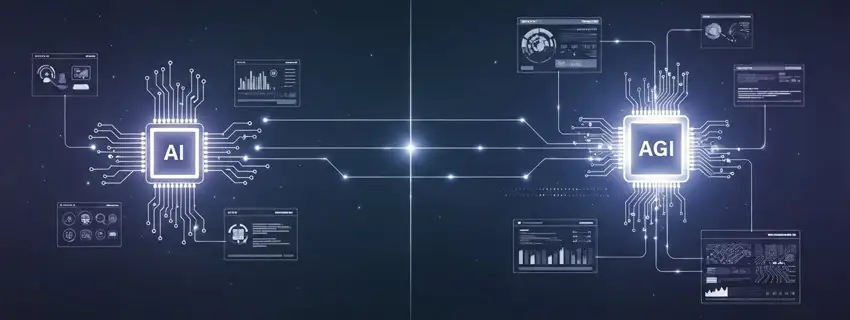
The development of multimodal AI agents, capable of understanding and combining different forms of input, such as text, images, audio and video, represents a concrete step towards achieving AGI, the coveted (and feared) Artificial General Intelligence that is expected to equal, if not surpass, human capabilities. The integration of different forms of perception and reasoning into a single coherent system is indeed enabling more general decision-making, superior adaptability and the ability to operate in complex environments.
Copyright information.
The images on this page were created using generative Artificial Intelligence tools.