

Vibe Copywriting:
Collaborating with AI to Write Better Content
Vibe copywriting” is a new way of writing that combines human creativity with the incredible capabilities of Artificial Intelligence. In this article, we’ll discover why this emerging skill is becoming strategic and how to best leverage it for the content we create.
( by: Antonio Maria Guerra | date: 20/03/2026 )

What is Vibe Copywriting?
Vibe copywriting is an emerging approach to content creation that blends the copywriter’s intuition and vision with the generative capabilities of Artificial Intelligence. The author defines goals, tone, structure and target audience, guiding the AI iteratively until the desired result is achieved: the text is progressively refined, so to speak, ‘prompt by prompt’. This is not automation: such a methodology makes it possible to produce targeted, scalable and stylistically consistent content, all within a much shorter timeframe. The machine can also suggest alternatives in real time, streamlining both revision and experimentation. It’s therefore no surprise that this approach is increasingly embraced by creators who need to balance speed, quality and consistency in their output.
The origin of the expression ‘Vibe Copywriting’.
The expression ‘vibe copywriting’ stems from a closely related one: ‘vibe coding’, coined by researcher Andrej Karpathy, who in 2025 began using it to describe an approach to programming in which software developers guide Artificial Intelligence by describing the desired outcome in natural language, leaving the machine to translate it into lines of code.
Read more
This approach was later adapted to communication: vibe copywriting thus refers to the practice of crafting content in collaboration with AI, so that the text aligns with the author’s intended style, delivering an output that matches the desired ‘communicative vibe’.

Artificial Intelligence does not suppress creativity but amplifies it.
Many believe, mistakenly, that the use of Artificial Intelligence inevitably flattens creativity, making every piece of content generic and, above all, ‘soulless’. The reality, however, is quite different … provided one knows how to master this innovative tool. AI, in fact, should not be used just as a ‘replacement’ for the copywriter, but rather as a kind of ‘inspired imitator’, genuinely capable of amplifying their style. The most advanced language models, when properly guided, can recognize and replicate a writer’s voice in a matter of moments, enhancing it and applying it across multiple assigned contexts. One of the key opportunities of ‘Vibe Copywriting’ therefore lies not in asking the machine to write an article from start to finish, but in having it work alongside us by adopting a specific persona, through which to work its ‘magic’. A magic rooted in the processing of the vast amount of data absorbed during its training.

Not Just AI: the importance of the ‘Human Factor’.
However ‘powerful’ Artificial Intelligence may be, human direction and oversight will always remain essential to achieving the best results with ‘vibe copywriting’. It all starts with the author’s ability to engineer the right prompt, providing precise instructions that are consistent with his personality and creative vision. He should also define the tone, level of complexity and target audience, thereby effectively guiding the machine. Without this input, the risk of generating generic content, far removed from the intended communicative goal, becomes quite high. It’s equally crucial that the writer evaluates and selects among the variants that are often suggested, correcting any errors and shaping the output according to his broader vision. In other words, AI can genuinely enhance its user’s work, but it is not, and never will be, capable of perfectly interpreting human intent and critical thinking. A truly effective outcome will always depend on a balanced combination of different skills.
Objective evaluation and online content optimization.
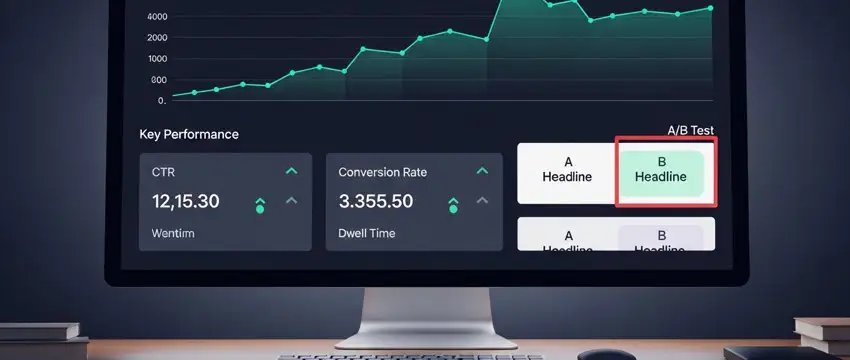
One of the key advantages of vibe copywriting lies in the real possibility of progressively improving not only the quality, but also the ‘desirability’ of content published online. The process starts with its evaluation, no longer based on subjective judgment, but on objective metrics designed to measure its impact. KPIs play a crucial role here, encompassing indicators such as conversion rate, average time spent on the content and bounce rate. Large-scale automated A/B testing also makes it possible to trial dozens of variants simultaneously, quickly identifying the most effective combinations. All this data continuously feeds the system, improving the accuracy of predictions and the quality of subsequent outputs. Vibe copywriting thus integrates with a data-driven approach that transforms this discipline from an intuitive art into an applied science, delivering predictable and replicable results.

The Tools of Vibe Copywriting.
Choosing the right technology for vibe copywriting is of paramount importance: the tools used directly shape the quality of the creative process, from stylistic consistency to the level of control that can be exercised over every detail of the generated content. Conversational Large Language Models (LLMs), such as ChatGPT, Gemini and Claude are, in all likelihood, the best option in this regard, enabling a strong iterative and dialogic relationship with Artificial Intelligence: it’s possible to feed them progressive inputs, requesting changes of varying degrees. Their flexibility gives the writer full control over structure, vocabulary and the direction of the message, with no constraints of any kind.

That said, it is worth noting that, alongside LLMs, the market also offers platforms specialised in ‘generic’ copywriting, such as Jasper, Copy.ai or Rytr. These tools rely on predefined templates and standardised workflows, designed for the rapid drafting of commercial copy such as emails, ads and social media posts. While they perform well for common use cases or for those seeking a more streamlined approach, their rigidity and limited iterative capabilities make them poorly suited to ‘pure’ vibe copywriting, which demands complete creative freedom and a dynamic relationship between the professional and AI.

The key advantages of Vibe Copywriting.
Collaborating with Artificial Intelligence in copywriting does not mean delegating creativity to the machine, but rather leveraging new technology to amplify one’s own cognitive and operational capabilities. The main benefits arising from this interaction include, among others:
- Overcoming ‘creative block’: the blank page ceases to be an obstacle. When initial inspiration is lacking, AI can immediately generate solid raw material to build upon, breaking through the creative stalemate and reigniting the flow;
- Speed of execution: a first draft of a long, structured piece can be produced in minutes rather than hours, immediately kickstarting the human/machine iteration cycles needed for progressive refinement;

- Access to a vast linguistic repertoire: AI can draw upon an extraordinarily broad linguistic heritage, combining syntactic structures, expressions and argumentative approaches that go far beyond one’s personal range. This makes it possible to break free from recurring formulas and explore solutions that would otherwise never have been considered;
- Ease of stylistic variation: dozens of versions of the same concept — each with a different tone, from the most empathetic to the most direct, from the most technical to the most narrative — can be generated in moments. This exploratory ease allows multiple options to be compared and the most effective one selected, without having to rewrite every variant manually;
- Structural consistency and completeness: AI makes it easy to maintain logical coherence in complex texts, ensuring that all required elements are developed. It systematically keeps track of narrative and argumentative threads, overcoming the limitations of human attention, which tends to ‘drop the ball’or even introduce inconsistencies;
- Productive scalability: AI enables the creation of multiple adaptations of the same content for different channels and audiences, adjusting the message accordingly. What once required days of work can now be accomplished in a matter of minutes;
- Cognitive energy reallocation: rather than exhausting mental resources on the mechanical production of text, one can channel creativity into high-value activities such as critical revision;
It should be emphasised that none of these advantages operate in isolation — they reinforce one another. The result is a faster, more efficient and qualitatively superior writing process, in which Artificial Intelligence does not replace the copywriter, but enhances their natural abilities.

The role of ‘Prompt Engineering’ in Vibe Copywriting.
Once LLMs have been identified as the ideal tool for putting vibe copywriting into practice, it’s worth taking a closer look at how to get the best out of them. This requires high-quality ‘prompt engineering’: in other words, the ability to craft clear and effective prompts (textual instructions). These must not only include all the information the AI needs to generate the desired content, but also be structured clearly enough to be correctly interpreted by the machine.
A well-crafted prompt should include, for example:
- The general context of the project;
- The specifications of the target audience;
- The objectives of the text;
- The constraints to respect, such as length or tone;
… not forgetting any relevant reference examples, which always prove extremely valuable.
The common temptation is to write very long prompts covering every possible detail. In practice, however, the most effective ones strike a balance between thoroughness and conciseness, providing essential information without overwhelming the AI with irrelevant details. A sound approach involves organising the prompt into clearly defined sections: one for context, one for the audience, one for objectives, one for style, and so on. This structure helps the machine process the request accurately, generating output that meets expectations.
When does Vibe Copywriting work best?
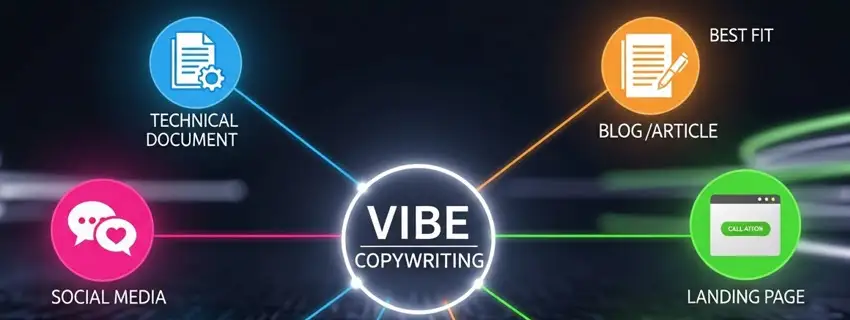
Vibe copywriting, however useful, is not a universal solution, since it excels mainly in specific contexts where tone, authenticity and stylistic consistency are decisive. Here are some examples:
- Social media content: on platforms such as LinkedIn, Instagram and TikTok, where a recognisable brand voice is essential, this approach makes it possible to build a distinctive style through progressive iterations;
- Email marketing and relational copywriting: in these cases, the methodology helps convey a sense of personalisation and relevance, preserving human warmth and contextual sensitivity;
Read more
- Blog articles: this is where vibe copywriting demonstrates its greatest value. Drawing on the professional’s expertise, AI structures, expands and refines the text without compromising the authenticity of the original voice;
- Landing pages and advertising copy: in formats that demand calibrated persuasion, AI helps articulate the product’s value and the emotions to be evoked through concise, high-impact messaging;
On the other hand, vibe copywriting is less suited to contexts where precision takes precedence over expressiveness, for instance technical manuals, software documentation, regulatory texts and scientific reports. In these areas, excessive focus on tone and style risks undermining the clarity and accuracy of the information, which remain the absolute priority.

Vibe Copywriting: mistakes to avoid.
One of the most common mistakes when starting out with vibe copywriting is uncritically accepting the first version generated by AI. The temptation, after all, is understandable: the text appears, at least on the surface, well written, covers all the required topics and contains no obvious errors. However, it is wise not to be misled: all automatically generated content naturally gravitates towards a kind of ‘competent mediocrity’, a grey area where everything is formally correct but nothing is really remarkable. The true value of vibe copywriting only emerges when time is invested in iteration, pushing AI beyond the obvious responses towards more interesting and distinctive territory.
Another typical mistake is providing vague prompts while expecting specific results. If, for example, we ask the machine to write something compelling about a product without explaining what makes it truly special, we will inevitably end up with generic content. The thoroughness and quality of the prompt directly determine the calibre of the generated text. Every minute invested in ‘directing’ the AI, refining and detailing the initial prompt, can save multiple subsequent revision cycles.

Vibe Copywriting: ethical considerations.
It’s only natural that the growing adoption of vibe copywriting should raise ethical questions worthy of reflection. Is it right to ‘disclose’ to readers that a piece of content was produced in collaboration with Artificial Intelligence? The answer is far from straightforward, not least because the boundary between ‘written by a human’ and ‘written by a machine’ grows thinner with each passing day. It should be noted, however, that in certain fields, such as journalism, institutional communication and medical content, transparency about the use of AI is already regarded as an ethical obligation, if not a regulatory one. If a copywriter uses AI to generate a first draft and then invests time in refining and perfecting it, should the final result be considered ‘artificial’? It is the author’s view that it should not, provided that the human contribution to the outcome has been meaningful. After all, the future points towards a landscape in which co-creation, to a greater or lesser degree, will inevitably be seen as entirely normal.

The limits of ‘Vibe Copywriting’ and how to manage them.
Despite recent and impressive progress, Artificial Intelligence still has some limitations in copywriting: it tends to produce texts that, although they may appear plausible, can contain factual inaccuracies, known as ‘hallucinations’. Models may also have difficulty fully grasping the user’s instructions and the stylistic nuances that one wishes to convey in the text. This, of course, does not make vibe copywriting unusable, but it does imply that human oversight remains essential and that generated content should always be carefully reviewed before publication.

Copyright information.
The images on this page were created using generative Artificial Intelligence tools.