

OpenEvidence:
The AI that Updates the Doctor’s work
AN EXCELLENT HEALTHCARE ‘COPILOT’
OpenEvidence is the Artificial Intelligence tool that is revolutionizing the way doctors access medical literature. Designed by two Harvard researchers, it is today used daily by more than 40% of American physicians. It answers clinical questions in ten seconds, has achieved a perfect 100% on the US medical licensing examination and is completely free. What it is, how it works and why it could soon change the practice of medicine worldwide.
( by: Antonio Maria Guerra | date: 17/04/2026 )

The information flood overwhelming doctors.
Try to imagine having to read two new scientific papers every minute, twenty-four hours a day, seven days a week. Not out of pure curiosity, but out of professional ‘obligation’, given that, potentially, any one of these studies could contain information that is decisive for your patients’ health. This, in fact, is the complex reality in which doctors around the world currently operate, or at least should operate. According to a paper published in the Transactions of the American Clinical and Climatological Association, medical knowledge is growing at an exponential rate, doubling over an ever-shorter period of time (*1). It follows that if a doctor simply wanted to stay current with the scientific literature in their own specialty, they would need, on average, around nine hours a day to do so, time obviously taken away from those in their care. The risks of this unsustainable ‘information overload’ are, on one hand, ignorance, and on the other, inevitably, burnout. According to the most recent data from the American Medical Association, in 2025 41.9% of American physicians reported symptoms of professional exhaustion (*2). Numbers that, while showing a modest improvement of late, remain deeply concerning.
It’s exactly in this context that OpenEvidence was born: a tool designed not to replace the doctor, but to put them in a position to make better clinical decisions, with the right information, at the right moment.
Notes
*1: Densen P., Transactions of the American Clinical and Climatological Association, 2011.
*2: American Medical Association, National Physician Comparison Report, 2025.

OpenEvidence: the origins.
The ‘OpenEvidence’ project took its first steps in 2022 in Cambridge, Massachusetts, from the inspired vision of two researchers who had both trained at Harvard University.
One of them, Daniel Nadler, a PhD in political economy, had already demonstrated his ability to turn informational complexity into competitive advantage: with Kensho, his first company, he had developed Artificial Intelligence systems capable of analyzing and synthesizing enormous quantities of financial data for Wall Street professionals. When S&P Global acquired Kensho in 2018 for 550 million dollars (*1), Nadler found himself facing a question: what other profession was drowning in a sea of unmanageable information? The answer was immediate: medicine.
Read more
Joining Daniel was Zachary Ziegler, a researcher specializing in the mathematical foundations of large language models, those that everyone today knows as ‘LLMs’. Together, the two ‘small geniuses’ conceived OpenEvidence, entrusting it with a precise mission: to organize and expand the world’s medical knowledge, making it available to every doctor, in a simple and reliable way.
Note:
*1: S&P Global, official press release, April 2018.

OpenEvidence: what it is.
OpenEvidence is, in essence, a genuine ‘medical search engine’, built on Artificial Intelligence and designed exclusively for verified healthcare professionals. The tool allows clinicians to ask clinical questions in natural language, receiving precise, up-to-date and fully documented answers within seconds, drawn exclusively from peer-reviewed scientific literature. It’s worth emphasizing that, unlike a traditional search engine, which returns a list of links to be examined one by one, OpenEvidence autonomously analyzes thousands of publications, synthesizes the most relevant evidence and presents it in a clear and immediately actionable format, accompanying every answer with verifiable bibliographic references.
It should also be noted that the platform, drawing only from rigorously vetted sources rather than the open web, is far less exposed to the risk of ‘hallucinations’, that is typical of generalist systems such as ChatGPT.
Read more
Its ultra-reliable and continuously expanding knowledge base currently comprises a corpus of over 35 million verified publications (*1), selected and licensed through official agreements with the world’s leading scientific institutions, including the New England Journal of Medicine, the Journal of the American Medical Association with all eleven of its specialty journals, as well as the National Comprehensive Cancer Network, the Cochrane and many others.
The result is an indispensable tool that, while making no claim to replace the doctor’s clinical judgment, can undoubtedly enhance it considerably, placing the best available scientific evidence at their disposal at the exact moment they need it.
Note:
*1: Contrary Research, OpenEvidence Business Breakdown, 2025.

OpenEvidence: top marks on the medical licensing examination.
To truly understand the quality of the Artificial Intelligence engine powering OpenEvidence, it is worth citing a piece of data that caused quite a stir in the medical world. In 2023, it was the first system to score above 90% on the American medical licensing examination, the USMLE, United States Medical Licensing Examination, a three-step test that every doctor must pass to obtain a license to practice in the United States (*1). An extraordinary milestone that, two years later, in August 2025, was comprehensively surpassed with the achievement of a perfect score of 100% (*2).
It should be noted that during the examination, the model did not simply provide the correct answer but explained the reasoning behind it, citing the scientific sources from which its conclusions were drawn.
This, in essence, is the heart of the philosophy of a tool that does not ‘guess’ but reasons, documents and justifies every statement.
Read more
*1: OpenEvidence, official press release, July 2023.
*2: OpenEvidence, official press release, August 2025.

OpenEvidence: an unprecedented success in the medical field.
The numbers behind OpenEvidence tell a success story that is hard to believe, even by the standards of the technology sector. Founded in 2022, just three years later the platform had reached 760,000 registered physicians in the United States, with over 18 million clinical consultations per month, up from approximately 3 million the year before (*1). More than 40% of American doctors use it daily, across over 10,000 hospitals and medical centers nationwide. Also in 2025, over 100 million Americans were treated by a healthcare professional who used OpenEvidence during their visit.
Read more
On the financial side, growth has been equally staggering: the company’s valuation rose from 1 billion dollars in February 2025 to 12 billion in January 2026, with approximately 700 million dollars raised in less than a year (*2). What makes this phenomenon even more remarkable is that it was not built through traditional marketing campaigns or costly commercial strategies: OpenEvidence spread exclusively through word of mouth, as happens with the best tools, those that recommend themselves because they genuinely work.
Notes:
*1 e *2: OpenEvidence, Series D announcement, January 2026.

Clinical answers in ten seconds or less!
The way OpenEvidence works in its core search mode is, in essence, remarkably simple: the doctor can ask a clinical question in natural language, exactly as they would put it to an expert colleague, and within five to ten seconds at most, receives a structured, documented answer accompanied by the bibliographic references of the sources from which it was drawn (*1). Such speed is, as one can easily appreciate, far from a minor detail, since it potentially allows for an effective consultation during every patient visit.
Read more
This is because OpenEvidence, from its very inception, was designed explicitly as a real-time support tool, to be used in the course of everyday clinical practice, and not merely as a resource to consult at the end of the day, when the doctor finally finds time to catch up. It’s also worth adding a factor of considerable practical relevance: the tool is completely free for all verified healthcare professionals, regardless of the institution in which they work. This comes at no cost to the user because the business model is based on advertising paid for by the pharmaceutical industry, which in this way reaches a vast audience of prescribing physicians. The formula clearly aligns perfectly with the platform’s interests: the more doctors use it, the greater the revenue and therefore the stronger the incentive to continuously improve the service offered.
Note:
*1: OpenEvidence, official press release, July 2025.

‘DeepConsult’: a research team … in your pocket.
Alongside its rapid search feature, OpenEvidence offers an even more powerful tool, designed for more complex clinical situations: it is called ‘DeepConsult’, and it is the first Artificial Intelligence agent designed specifically for physicians (*1). The way it works is decidedly different from standard search because, rather than returning an immediate, or near-immediate, answer, DeepConsult, like a kind of dedicated team, autonomously analyzes hundreds of peer-reviewed studies in parallel, cross-referencing and synthesizing them, looking not only for direct answers but also for cross-cutting connections between findings in the literature that might otherwise go unnoticed.
Read more
The result is then delivered to the physician within a matter of hours in the form of a comprehensive, academically rigorous report. To give a sense of the scale: what a human researcher would take months to produce on a single clinical topic, DeepConsult delivers to the doctor’s inbox, perhaps while they are having lunch. This feature too, despite requiring enormous computing power, is completely free for all verified healthcare professionals. A detail far from negligible, given that similar services are often sold for tens of thousands of dollars per month.
Note:
*1: OpenEvidence, official press release, July 2025.

OpenEvidence: the doctor always stays in command.
A question arises naturally: does the existence of a powerful tool like OpenEvidence put the ‘real-life’ doctor at risk? The answer is categorical: no. The philosophy underlying the tool from its very inception is that the doctor is and will always remain the final decision-maker, bearing clinical responsibility in every case.
OpenEvidence does not diagnose, does not prescribe and does not replace the professional’s judgment. What it does instead is support its ‘human counterpart’, enhancing their capabilities in much the same way that the Bloomberg terminal amplifies the analytical possibilities of the trader.
Daniel Nadler often uses an effective analogy: computers have been capable of landing planes autonomously for a long time, yet pilots are still present in cockpits. Why? Because in medicine, as in aviation, there are considerations that go well beyond pure computational capability: empathy, contextual judgment, the relationship with the patient, ethical responsibility.
Read more
That said, the context in which OpenEvidence operates is far from lacking urgency: according to projections from the American government, by 2036 the United States could face a shortage of up to 86,000 physicians (*1). In such a scenario, tools capable of multiplying the capabilities of those currently practicing will not be a luxury, but a necessity!
Note:
*1: AAMC, The Complexities of Physician Supply and Demand: Projections From 2021 to 2036, March 2024. https://www.aamc.org/media/75891/download
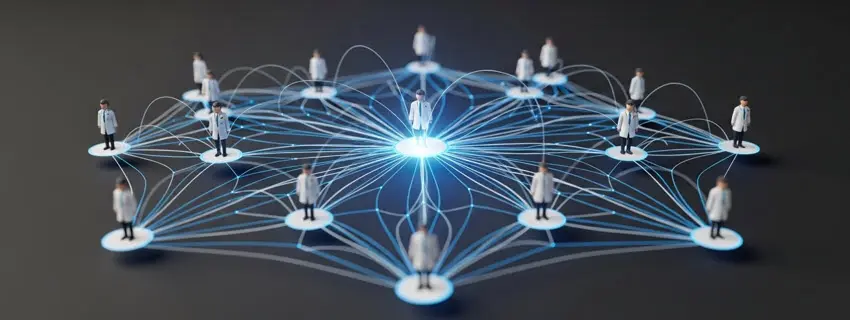
The vision: AI as a bridge between doctors.
Looking at the future of OpenEvidence, Daniel Nadler outlines a vision that goes well beyond a simple medical search engine. His ambition, publicly stated on multiple occasions, is to make his creation a kind of ‘connective tissue’ for the entire global healthcare system: a tool that does not simply provide answers drawn from scientific literature, but becomes the point of connection between experts around the world.
His idea is undoubtedly compelling: a professional dealing with a rare or particularly complex clinical case could, by using the tool, be rapidly connected with the most qualified specialist in the world for that specific condition, regardless of where they are located. In this vision, the role of Artificial Intelligence would not be to provide answers, but to facilitate and optimize as much as possible the connection between one human being and another. A perspective radically different from the dystopian one that often accompanies the debate around AI in medicine, it must be said.
Read more
On a more immediate front, OpenEvidence is already expanding its reach beyond clinical research: it has recently launched an automatic transcription tool for medical visits, allowing the doctor to devote more time to the patient and less to documentation.
Small steps toward a form of medicine in which technology works for people, and not the other way around.

OpenEvidence in Italy: where do things stand?
A legitimate question concerns the availability of OpenEvidence for Italian physicians. The answer is nuanced: the tool is currently designed and optimized for the American market. Its verification system is based on the NPI, the National Provider Identifier, an identification code exclusive to the US healthcare system, and European professionals often encounter difficulties during the registration process, finding themselves locked out of some of the platform’s features. The knowledge base, moreover, is heavily oriented toward American guidelines and regulatory context.
Read more
That said, international expansion is undoubtedly in the plans of the company, with English-speaking markets as the immediate priority. For the time being, OpenEvidence therefore represents for Italian physicians a tool of great interest, one to follow closely, while awaiting full access that, we hope, will not be long in coming.
Copyright information.
The images on this page were created using generative Artificial Intelligence tools.